The Violentómetro
An educational resource for recognising manifestations of violence that can be mistaken for affection or go unnoticed.
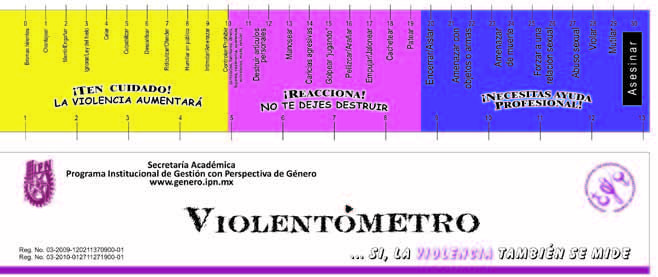
I created it at the Instituto Politécnico Nacional in 2009, following a study of relationships among its students. The ruler names controlling behaviours, physical aggression and sexual violence, organised into three levels of alert.
When violence is interpreted as affection
In the 2009 study, the authors described controlling behaviours and aggression that students could understand as affection, attention or a normal part of a relationship.
Behaviours described in the study
- Jealousy and restrictions
- Constant phone calls
- Dictating clothing or behaviour
- Hitting presented as play
could be interpreted as
Interpretations reported by the authors
- Affection
- Attention
- Something normal in a relationship
The problem of recognising these experiences informed the creation of the Violentómetro: making manifestations of violence visible and giving them a name.
Read the historical ruler
The colours distinguish three levels of alert. Open each band to read its behaviours.
The behaviours can occur in different combinations. Their position on the ruler does not mean that someone will experience all of them or encounter them in that order.

Violentómetro
Original design · Digital readingBe careful! Violence will increaseView behavioursClose behaviours
- Hurtful jokes
- Blackmail
- Lying / Deceiving
- Ignoring / The silent treatment
- Jealousy
- Blaming
- Belittling
- Ridiculing / Insulting
- Humiliating in public
- Intimidating / Threatening
- Controlling / Forbidding
React! Do not let yourself be destroyedView behavioursClose behaviours
- Destroying personal belongings
- Groping
- Aggressive touching
- Hitting “as a joke”
- Pinching / Scratching
- Pushing / Shoving
- Slapping
- Kicking
- Locking in / Isolating
You need professional help!View behavioursClose behaviours
- Threatening with objects or weapons
- Threatening to kill
- Forcing sexual intercourse
- Sexual abuse
- Rape
- Mutilation
- Killing
Controlling or forbidding: friendships, family contact, money, places, clothing, activities, email or phone use.
Instrument created by Martha Alicia Tronco Rosas · Instituto Politécnico Nacional
Digital presentation of the behaviours and alerts in the historical design documented by the IPN in 2012. The layout adapts to the screen; the published image is preserved below. The English labels are a working translation.
View the ruler in the original publication
Updates and later research
Updates to the material and projects studying it have their own dates and purposes.
- 2021
The IPN adds digital violence
The update includes sharing intimate content without consent, sextortion and stalking on social networks.
Read the IPN announcement (Spanish) - 2025
Reviewing its impact after fifteen years
The IPN’s project listing records Martha’s research on the Violentómetro’s impact as a prevention tool and the institution’s contribution to the world.
View the project in her research record (Spanish)
Family environment and beliefs about feelings
A recent survey linked to the Violentómetro research explores family life and beliefs about gender roles. These results come from a different survey from the 2009 study.
Feeling heard at home
The proportion of people who feel heard varies according to how they describe their family environment.
16,035 records. Percentages within each family environment.
Two selected responses from the family section. A person may give both responses; the comparison does not establish causation.
View responses, counts and source
| Group | Base | Heard | I avoid being at home |
|---|---|---|---|
| Democrático (cooperación). | 7,670 | 5,795 | 481 |
| Permisivo (no interferencia). | 3,628 | 2,497 | 368 |
| Sobreprotección. | 2,039 | 970 | 440 |
| Autoritaria (dictadura). | 1,684 | 889 | 386 |
| No se involucra | 1,014 | 493 | 221 |
Men and the expression of feelings
Rejection of this idea was more frequent among those who answered “Woman” than among those who answered “Man” to the question about sex.
“Men should not show their feelings”
Answered “No, not at all”
16,034 records. Percentages within each response to the question about sex.
View responses, counts and source
| Group | Base | No, not at all | I don’t know | Yes, completely |
|---|---|---|---|---|
| Woman | 7,841 | 5,618 | 878 | 1,345 |
| Man | 7,982 | 4,153 | 2,285 | 1,544 |
| Prefer not to answer | 211 | 120 | 46 | 45 |
Scope of these results
Source: aggregate Dashboard Encuesta tables supplied for this research. The available file does not state the fieldwork date or how participants were selected. These figures describe the recorded responses; alone, they cannot estimate frequency across the wider population or the effectiveness of the Violentómetro.
Each percentage divides the response count by its group’s base and is rounded to one decimal place. Family labels are shortened; the table retains the original categories. Family responses may overlap. The export does not explain the difference of one record between the two sections. English labels are working translations of the Spanish responses.
Accessing, citing and using the material
The reference publication
The historical ruler and the account of its creation in the IPN’s 2012 publication.
Open the PDF at page 28 (Spanish)Citation, reproduction and permissions
Bibliographic reference, credits and guidance on reproducing or adapting the material.
Read the use and permissions guidance